
Mitral Valve Disease
Mitral Valve Disease
What is mitral valve disease?
The mitral valve is the gateway between the lungs and the heart. Oxygenated blood from the lungs enters the heart and flows through the mitral valve into the heart’s pumping chamber (left ventricle). The left ventricle pumps blood out to the rest of the body through the aorta. When the left ventricle contracts, the mitral valve’s two leaflets close to prevent blood from flowing backward.
The mitral valve also has a series of supporting fibers (chords) and muscles attached to the leaflets. These structures prevent the leaflets from bulging back into the atrium (prolapsing). But if the mitral valve leaks or tightens up, blood can back up into the lungs. The two main types of mitral valve disease are:
- Mitral valve regurgitation: This occurs when the leaflets of the valve do not close tightly and blood flows back into the left atrium. Approximately 90% of mitral valve problems are due to regurgitation.
- Mitral valve stenosis: This occurs when the leaflets become thick and the valve narrows, reducing blood flow.
Normal function of the mitral valve
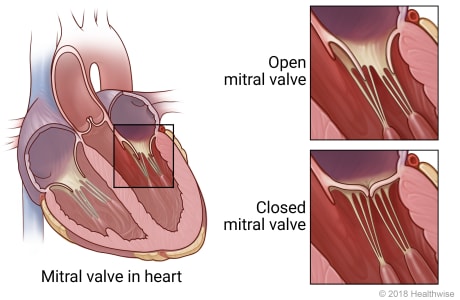
The mitral valve is one of four valves in the heart. It regulates blood flow from the upper left chamber (left atrium) into the lower left chamber (left ventricle). The left ventricle is the heart's main pumping chamber.
A normal mitral valve has two flaps, or leaflets. When the heart pumps, blood forces the flaps open, and blood flows from the left atrium to the left ventricle. Between heartbeats, the leaflets close tightly so that blood does not leak backwards through the valve.
Our Approach
The Frankel Cardiovascular Center’s Comprehensive Heart Valve Program is nationally renowned for mitral valve treatment. Our team includes several of the world’s leading mitral valve surgeons. Under our expert care, you’ll receive the right diagnosis and treatment options that best meet your needs.
Features of our mitral valve care include:
- Expertise: In addition to being recognized as one of the best centers for mitral valve repair, three of our surgeons are recognized as Mitral Valve Repair Reference Surgeons. Among all centers to have received this award, no other has more than two surgeons with the highest level of proficiency in mitral valve repair.
- Advanced procedures: We offer the most sophisticated treatments for the mitral valve, including new transcatheter approaches only available through clinical trials. Our participation in major clinical trials provides patients access to new treatment options.
- Patient-centered care: We know how important it is for patients and their families to receive personal care. More than 95% of our patients are extremely satisfied with their cardiovascular care at the Frankel Cardiovascular Center.

Michigan Medicine is honored to be one of the first 5 medical centers recognized for best practices in heart valve repair with The Mitral Valve Repair Reference Center award. This award was initiated by the Mitral Foundation and the American Heart Association to assist patients and cardiologists in identifying hospitals with excellent processes and outcomes.
Clinical Trials
Doctors at Frankel Cardiovascular Center are leading the development of new mitral valve treatments through clinical trial research. These trials offer less invasive procedures with excellent patient outcomes. For some new treatments, we are the only center in Michigan that offers clinical trial access for eligible patients.
Appointment Information
To schedule an evaluation with a Frankel Cardiovascular Center physician, call 888-287-1082. Or visit the Make a Cardiovascular Appointment page to learn what to expect when you call us.
What are the symptoms of mitral valve disease?
Mitral valve disease often progresses gradually and may be undetected for years. As the disease advances you may notice:
- Dizziness or lightheadedness
- Fatigue
- Irregular heartbeat
- Shortness of breath
Rarely, sudden mitral valve regurgitation may occur due to a heart infection or tearing of the fibers (chords) or muscles that support the mitral valve. This condition requires emergency care and usually replacement of the mitral valve.
Mitral valve disease can cause other heart and lung conditions such as:
- Atrial fibrillation (irregular heartbeat)
- Cardiomyopathy (heart muscle disease)
- Heart failure
- Pulmonary hypertension (increased blood pressure in the lungs)
- Tricuspid valve disease
How is mitral valve disease diagnosed?
The first indication of mitral valve disease is often a murmur your doctor hears when listening to your heart. A murmur is an abnormal whooshing sound of blood flowing through the damaged valve.
To confirm the diagnosis, your doctor will order an echocardiogram of your heart. This test uses ultrasound waves that show the motion of your heart and valves. Echocardiograms can be done through the chest (transthoracic) or through the throat (transesophageal). A transesophageal echocardiogram (TEE) is often the test of choice because it produces clearer images of your heart.
Your doctor may order other tests to determine the right treatment approach:
- Cardiac catheterization, where a catheter (thin tube) is inserted into a blood vessel in your groin, neck or arm and threaded to your heart. This technique can be used to diagnose and treat heart conditions. In mitral valve disease, TEE is used during cardiac catherization to get a closer look at the valve and assess valve function.
- CT scan, which is type of X-ray. At Frankel Cardiovascular Center, our imaging specialists use a unique protocol for performing a cardiac CT scan. It allows us to collect images through the entire heartbeat. A CT scan is often used to determine the most appropriate treatment option, such as a transcatheter or minimally invasive surgical approach.
How is mitral valve disease treated?
Within the Comprehensive Heart Valve Program, our team of cardiologists, surgeons and other specialists are skilled in a wide range of techniques. Their diverse expertise allows us to develop individualized treatment plans for each patient. Some of the treatments we offer include:
- Nonsurgical treatment with medications, lifestyle changes and monitoring. This approach is often used for patients with mitral valve conditions that are caused by other heart problems such as heart failure.
- Transcatheter procedures that use small tubes (catheters) to repair or replace mitral valves. These treatments are available to patients who are not candidates for minimally invasive or open-heart surgery.
- Minimally invasive surgery, which the surgeon performs through an incision between the ribs.
- Open-heart surgery, which involves opening the chest cavity. In patients with severe mitral valve prolapse, open-heart surgery is the treatment of choice and yields better long-term outcomes.
Locations
-
Cardiac Surgery Clinic | Frankel Cardiovascular Center 1425 E Ann St
Floor 3 Reception C
Ann Arbor, MI 48109-5856Get Directions -
Cardiology Clinic | Frankel Cardiovascular Center 1425 E Ann St
Floor 3 Reception C
Ann Arbor, MI 48109-5856Get Directions -
Multidisciplinary Valve Clinic | Cardiovascular Center 1425 E Ann St
Floor 3 Reception C
Ann Arbor, MI 48109-5856Get Directions
Doctors

Gorav Ailawadi, MD, MBA
Professor
Thoracic Surgery, Surgery

Steven Fredric Bolling, MD
Professor
Thoracic Surgery, Surgery

Stanley Joseph Chetcuti, MD
Clinical Professor
Interventional Cardiology, Cardiovascular Disease, Internal Medicine

Neal Murari Duggal, MD
Clinical Assistant Professor
Anesthesiology

Andrew Wesley Harris, MD
Clinical Assistant Professor
Cardiovascular Disease, Internal Medicine

Megan Shetty Joseph, MD
Clinical Assistant Professor
Cardiovascular Disease, Internal Medicine

Taylor Alexander Lebeis, MD
Clinical Assistant Professor
Advanced Heart Failure & Transplant Cardiology, Internal Medicine, Cardiovascular Disease

Daniel Stephen Menees, MD
Clinical Associate Professor
Interventional Cardiology, Cardiovascular Disease, Internal Medicine

Matthew Augustin Romano, MD
Clinical Professor
Thoracic Surgery, Surgical Critical Care
Providers

Brittany George, NP
Advanced Practice Nurse
Nurse Practitioner

Mary Elayne-Assenmacher Judd, NP
Advanced Practice Nurse
Nurse Practitioner
News & Stories

Treating a rare coronary artery aneurysm without open heart surgery

A heart attack 9 days after giving birth: Mother of 4 shares her SCAD experience

Failed TAVR? Heart surgeons explain TAVR explant, options and risks

2 heartbeats, 1 future: Why pregnancy is a critical window for women’s heart health

Delays in Heart Surgery for Women due to One-Size-Fits-All Criteria

