
Contact Dermatitis & Patch Testing
Contact Dermatitis & Patch Testing
What are contact dermatitis & patch testing?
Contact dermatitis is a red, itchy rash that occurs when the skin comes into contact with a substance that causes the immune system to mistakenly think the skin is under attack. Because treatment of contact dermatitis includes avoiding contact with the substance(s) that trigger the reaction, identifying the cause is key. The U-M Dermatology Patch Testing Clinic at Domino's Farms provides care to patients with suspected contact dermatitis.
Patch testing is a method used to detect contact allergies to specific substances that come in contact with the skin. These substances (or allergens) may be found in personal care products (lotions, soaps, hair dyes, perfumes, cosmetics, etc.), topical medications, shoes, clothing, jewelry and many other sources. We currently patch test patients to a standard series of 80 allergens called the American Contact Dermatitis Society (ACDS) Core Allergen Series. We frequently test patients to their personal care products, as well.
Contact dermatitis
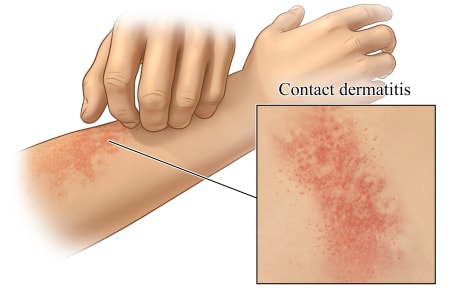
Contact dermatitis is a skin rash that results from contact with a substance that causes an allergic reaction. Or it can occur from contact with a substance that irritates the skin. A minor reaction may cause mild color changes of the skin, itching, or a rash of small bumps. A more severe reaction may cause pain, swelling, and larger blisters. In lighter skin, the rash may look pink or red. In darker skin, the rash may be hard to see or it may look dark brown, gray, or purple.
Many things can cause contact dermatitis, including soaps, lotions, latex gloves, and plants such as poison ivy. The location of the rash may provide a clue about the cause.
How can you care for dermatitis?
- Do not scratch the rash. Cut your nails short, and file them smooth. Or wear gloves if this helps keep you from scratching.
- Wash the area with water only. Pat dry.
- Put cold, wet cloths on the rash to reduce itching.
- Keep cool, and stay out of the sun.
- Leave the rash open to the air as much as possible.
- If the rash itches, use hydrocortisone cream. Follow the directions on the label. Calamine lotion may help for plant rashes.
- If itching affects your sleep, ask your doctor if you can take an antihistamine that might reduce itching and make you sleepy, such as diphenhydramine (Benadryl). Be safe with medicines. Read and follow all instructions on the label.
- If your doctor prescribed a cream, use it as directed. If your doctor prescribed medicine, take it exactly as directed.
Dermatitis: When to call
Contact your doctor now or seek immediate medical care if:
- You have symptoms of infection, such as:
- Increased pain, swelling, warmth, redness, or other changes in skin color.
- Red or dark streaks leading from the area.
- Pus draining from the area.
- A fever.
- You have joint pain along with the rash.
Watch closely for changes in your health, and be sure to contact your doctor if:
- Your rash is changing or getting worse.
- You are not getting better as expected.
Appointment Information
To make an appointment for contact dermatitis or patch testing, call 734-936-4054.
News & Stories

Researchers identify a potential “Achilles heel” of psoriasis
Dermatology resident’s China rotation highlights value of global training

New study hints at cause of pachyonychia congenita and a long-awaited potential treatment
New study hints at the cause of a painful skin condition—and at a long-awaited potential treatment

Single-cell RNA sequencing gives insight to dermatomyositis treatment

