
Cataract
Cataract
What is a cataract?
A cataract is a clouding of the lens of your eye. As you age, proteins in your lens begin to break down and the lens becomes cloudy. You may not even realize you have a cataract because it usually grows very slowly and may not impede vision early on. While cataracts are rarely dangerous, after a number of years they will likely affect vision. By age 65, over 90 percent of people have a cataract; half of the people between the ages of 75 and 85 have lost some vision due to a cataract. A cataract is not caused by overuse of your eyes, and it does not travel from one eye to the other.
Cataract
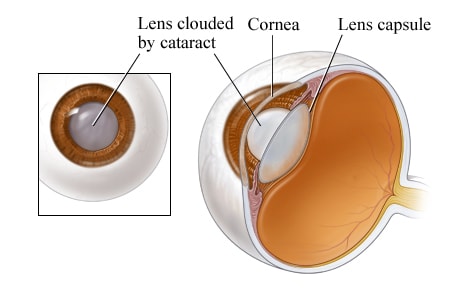
A cataract is a partial or complete cloudiness in the lens in the eye. The lens is enclosed by the lens capsule. The cornea is the clear outer layer at the front of the eye.
Understanding cataracts and cataract surgery
This video provides a clear and helpful guide to understanding cataracts and cataract surgery. It explains what cataracts are, how they are diagnosed, and the details of the cataract surgery procedure, which replaces your eye's cloudy lens with a clear artificial one. You'll also learn what to expect during your recovery and how this surgery can significantly improve your vision and quality of life.
Appointment Information
To make an appointment, call 734-764-4190.
What are the symptoms of a cataract?
Some of the symptoms of cataract include:
- A decrease in the clarity of vision that is not correctable with glasses
- Colors that appear faded or washed out
- Sensitivity to light, glare; halos around lights
- Frequent changes to eyeglass prescriptions
An ophthalmologist or optometrist will be able to diagnose a cataract during a dilated eye examination.
What can cause cataracts?
The human lens is transparent so that light can travel through it easily. It has no blood supply and is 65 percent water. Although new cells are being made for the lens continuously throughout our lifetime, many factors combine as we age to cause areas in the lens to become cloudy, hard and dense. The lens can then no longer transmit a clear picture to the retina where it can be processed and sent through the optic nerve to the brain. Cataracts can have many causes, as described below.
- Age-related: This is the most common kind of cataract. There are three subclassifications, based on location: nuclear, cortical and posterior subcapsular.
- Congenital: Although it is not common, some babies are born with cataracts or develop them within the first year of life.
- Traumatic: This type of cataract results from an injury to the eye.
- Secondary: This is a cataract that is caused either by medications (most commonly prednisone or other corticosteroids) or disease, like diabetes. Cataracts are 10 times more common in diabetic patients than in the general population.
What are the risk factors of cataracts?
- Aging
- Heavy drinking
- Smoking
- Obesity
- High blood pressure
- Previous eye injuries
- Family history
- Too much UV light (sun) exposure
- Diabetes
- Exposure to radiation from x-rays and cancer treatments
How are cataracts diagnosed?
Cataracts can be diagnosed by your eye care professional during a dilated eye exam. You may also have your vision checked in different lighting conditions and with an updated glasses prescription. Imaging or invasive testing is not required to diagnose a cataract. A complete eye exam is necessary to determine if anything else is contributing to your visual symptoms.
How are cataracts treated?
Once cataracts have formed, the only treatment is surgical removal of the cataract and replacement with an artificial lens. Cataract surgery is typically performed on an outpatient basis under local anesthesia. When the cataract has become severe enough that it compromises your quality of life, you and your ophthalmologist will discuss the appropriate time to remove it.
Locations
-
Comprehensive Ophthalmology & Cataract Surgery Clinic | Kellogg Eye Center 1000 Wall St
Floor 1
Ann Arbor, MI 48105-1912Get Directions -
Ophthalmology Clinic | Brighton Center for Specialty Care 7500 Challis Rd
Entrance 1, Level 2
Brighton, MI 48116-9416Get Directions -
Ophthalmology Clinic | Canton Health Center 1051 N Canton Center Rd
Canton, MI 48187-5097Get Directions -
Ophthalmology Clinic | Chelsea Health Center 14700 E Old US Highway 12
Floor 1
Chelsea, MI 48118-1185Get Directions -
Ophthalmology Clinic | Northville Health Center 39901 Traditions Dr
Floor 2
Northville, MI 48168-9493Get Directions -
Ophthalmology Clinic | West Ann Arbor Health Center-Parkland Plaza 380 Parkland Plaza Ste 210
Floor 2
Ann Arbor, MI 48103-6201Get Directions
Doctors

Jill Elizabeth Bixler, MD
Clinical Assistant Professor
Ophthalmology

Theresa M Cooney, MD
Clinical Associate Professor
Ophthalmology

Julia Dalia, MD
Clinical Assistant Professor
Ophthalmology

Pauline Dmitriev, MD
Clinical Assistant Professor
Ophthalmology

Angela Renee Elam, MD, MPH
Assistant Professor
Ophthalmology, Oculoplastics Ophthalmology

Charles Ross Frank, MD
Clinical Assistant Professor
Ophthalmology

Sarah Jayne Garnai, MD
Clinical Instructor
Ophthalmology

Farida Esaa Hakim, MD
Clinical Assistant Professor
Ophthalmology

Sean Owen Hansen, MD
Clinical Assistant Professor
Ophthalmology

Christopher Thomas Hood, MD
Clinical Associate Professor
Ophthalmology


News & Stories

Susan J. Lane: Gratitude and Giving

Cell death in photoreceptor cells is reversible, study finds

Uncovering how occludin protein maintains blood-brain and blood-retinal barriers

Poor vision plus unsafe homes drive higher fall risk in seniors

Doctors restore patient’s vision with progressive eye disease

